 Beltfinance
: BELT Buyback Destinations
Last updated -
Belt Finance's documented policy uses part of its swap fees to buy BELT and burn it. Yield-funded buybacks split between burns and, in the documented BNB Chain implementation, BELT single-staking rewards.
- Trading-fee burn share
- 50% of stable-swap trading fees fund BELT purchases for burning under the documented policy.
- Strategy-yield burn share
- 8% of earned strategy yield funds BELT purchases for burning under the documented policy.
- Strategy-yield staking share
- The documented BNB Chain implementation uses an additional 4% of base strategy yield to buy BELT for the BELT single staking vault.
Allocation bases
Trading-fee buybacks draw from the fees that Belt Finance's stable-swap AMM collects. The 50% share applies to collected fees, not the total value of assets traded. The BELT token document assigns the remaining half of trading fees to liquidity providers.
Yield buybacks draw from earnings that the underlying beltStrategy contracts generate. In the documented BNB Chain implementation, the burn and staking allocations together use 12% of earned strategy yield. The 8% and 4% shares apply to earned yield, not the principal that a user deposits.
Burns and staking rewards
The burn mechanism sends purchased BELT to a burn address, permanently removing those tokens from circulation. On BNB Chain, the staking allocation instead directs purchased BELT to the BELT single staking vault for participants.
The BELT Single Staking document describes automatic compounding and a seven-day deposit lockup for that BNB Chain implementation. Every deposit resets the lockup to seven days, including an additional deposit near the previous lockup's end.
Execution and governance
The Buyback & Burn Policy describes yield buybacks with each beltStrategy contract's
earn()
transactions, scheduled every 12 hours. It describes one daily
buyback()
execution for trading fees accumulated in the swap contract.
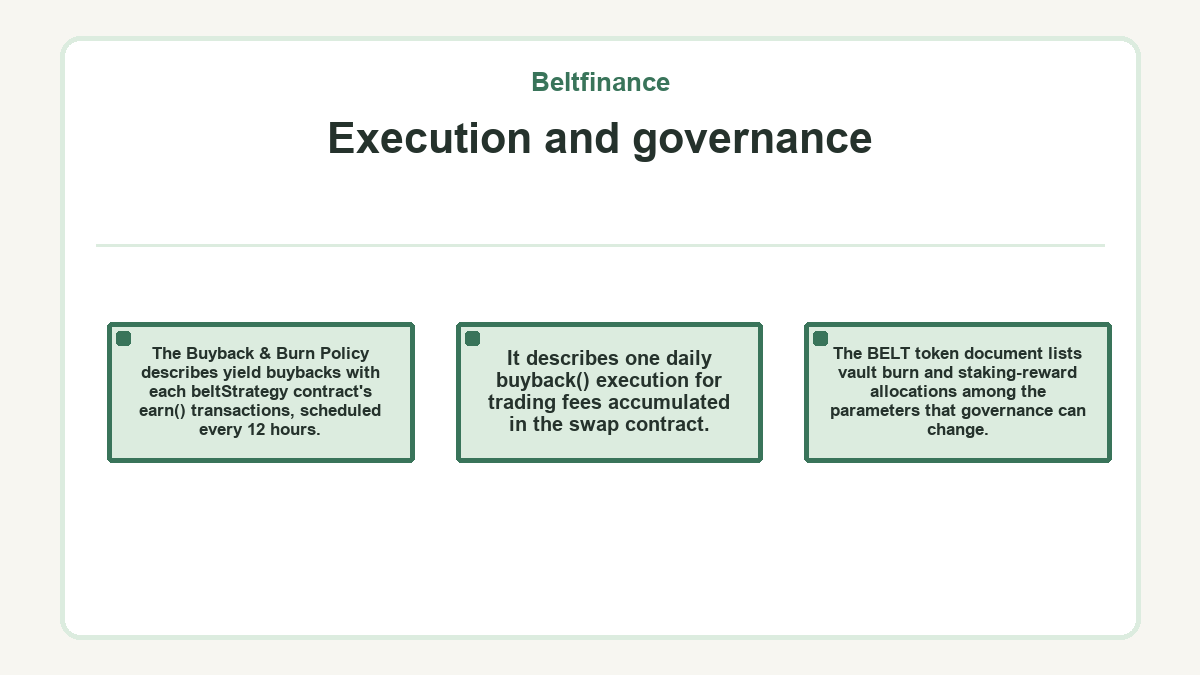
The BELT token document lists vault burn and staking-reward allocations among the parameters that governance can change.
Buybacks and net supply
A buyback purchases existing BELT; its destination determines whether those tokens go to burning or staking rewards. The supply policy aims for burns to exceed emissions, but allocation percentages alone do not establish that outcome. That comparison requires the amounts burned and newly issued over the same period.
Buyback classification checklist
- For swap-funded purchases, identify the collected trading fee as the percentage base and burning as the BELT destination.
- For yield-funded purchases, separate the burn share from the share that funds BELT single-staking rewards in the documented BNB Chain implementation.
- For single-staking access, account for the documented seven-day lockup and its reset with every deposit.